Claude helped prove software properties. Here is what “verified” covers.
Anthropic and Theorem’s October 22 research points toward more checkable AI coding. The proof’s exact promise matters as much as its size.
The 30-second bite
- Anthropic reports a Claude-assisted verification campaign covering security properties across 123 open-source libraries.
- A proof checker evaluates the argument; the model’s confidence is not the acceptance test.
- The public artifacts describe specific binaries, properties and assumptions. They do not certify every use of a library.
The useful promise is a precise one
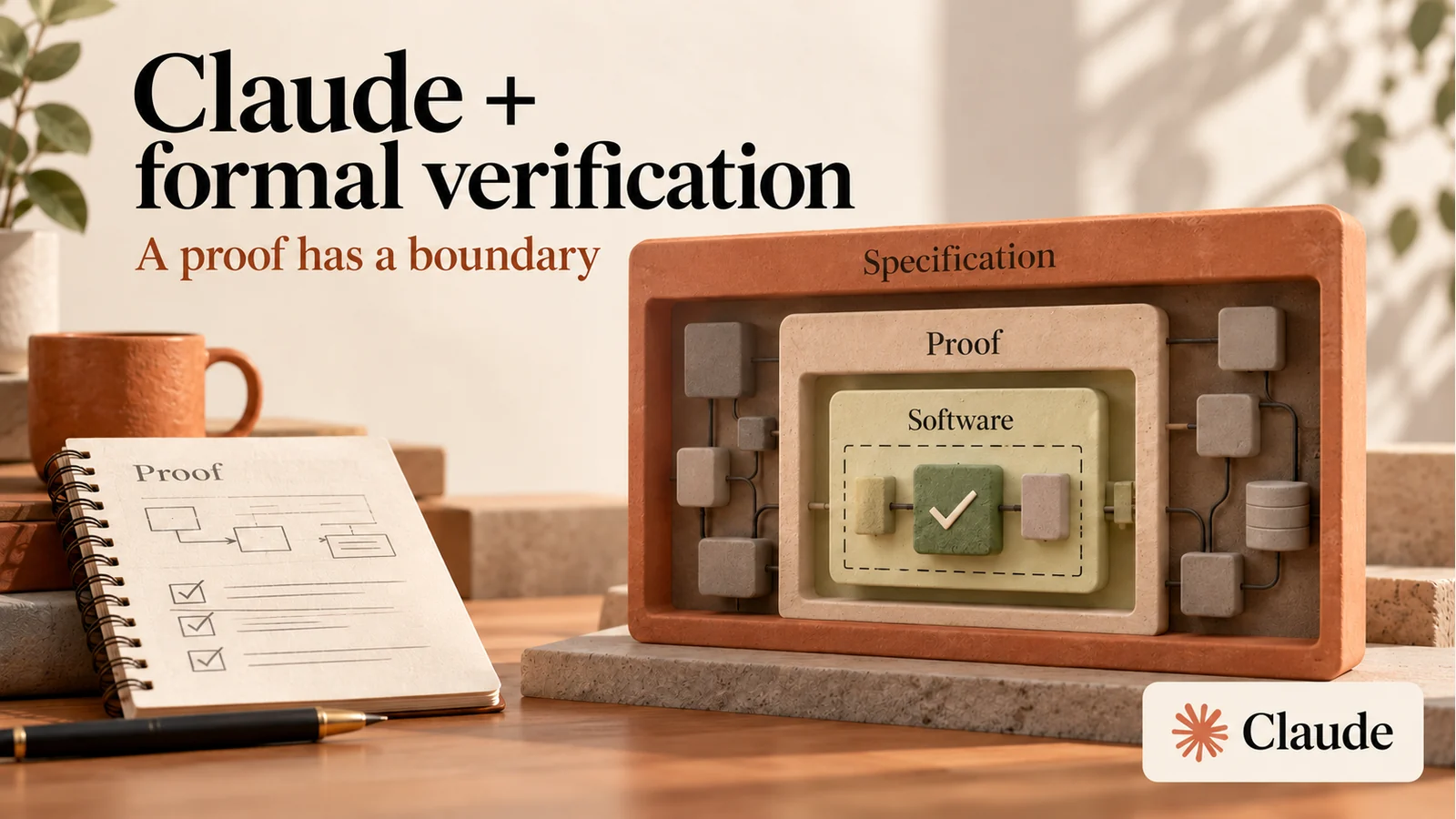
On October 22, Anthropic described work with Theorem using Claude to generate formal proofs for open-source software. Its campaign covered 123 libraries. The reported no-crash guarantees applied to specified single-threaded, static RISC-V Linux programs, with fixed memory budgets and inputs below 64 MB.
The reader-facing question is straightforward: can AI help produce evidence about code, alongside producing the code itself? That could be valuable for software people rely on without ever seeing. But “proved a defined property” and “this library can never go wrong” are very different statements. The former is what deserves attention here.
Sources: [1]
The model proposes; a checker decides
Rocq’s own documentation describes a system for stating software specifications and developing proofs that a relatively small kernel can machine-check. In this arrangement, an AI system can help construct an argument, while acceptance depends on the proof system rather than a persuasive explanation in chat.
A useful analogy is an answer submitted with working that must satisfy strict rules. Our interpretation is that separating proposal from checking changes the trust question: you can ask what statement was accepted and by which checker. It does not remove the need to examine whether that statement captures the behavior you actually wanted.
The published subset is smaller than the campaign
When checked on October 29, Theorem’s public proof repository listed 61 entry points across 26 libraries. That is an inspectable subset, not a second count of the entire research campaign. The repository says its proofs concern compiled binaries and identifies the Linux-process model, LPS, used to state them.
An entry point is a particular route into a program, such as feeding bytes into a parser. For a reader assessing a sweeping claim, this is the detail to look for: which routes and builds are covered? The published collection gives a more concrete starting point for scrutiny than the larger library count alone.
Sources: [2]
A checked proof still has boundaries
The repository distinguishes agreement statements from termination statements. Agreement between a plain build and a sanitizer build does not, on its own, establish that execution finishes. It also warns that LPS is incomplete and makes assumptions it does not check, and that proof coverage is tied to the release’s binaries.
Consider a hypothetical image tool. Showing that one specified entry route avoids a defined crash class would not establish that every image is rendered correctly, that a different platform behaves identically or that callers use the tool appropriately. Those are separate questions. Narrow guarantees can still be valuable; their value is easier to judge when the boundary is explicit.
Sources: [2]
Why reuse could change the economics
Theorem’s earlier roadmap, published September 29 and updated October 19, proposes verifying shared components and reusing their verified interfaces across dependent software. It uses the Nix package ecosystem as a planning case study. Its future coverage and cost estimates depend on assumptions about continued progress; they are not completed results.
Our reading is that reuse is the more useful idea for a general audience than a distant target date. Many applications depend on common foundations. If a relevant proof can travel with a well-defined component, the benefit could extend beyond the team that first paid to create it. Maintaining that link as software changes remains part of the job.
Sources: [3]
What to ask about the next “verified” claim
Ask for the property in ordinary language, the exact artifact it covers, the permitted inputs and the assumptions about the environment. Then ask where the statement and checking instructions can be inspected. A library name on a slide is not enough to answer those questions.
For maintainers, a useful next question is what happens after a dependency or compiler changes: which evidence remains applicable, and what must be proved again? For everyone else, the immediate benefit is a better way to read AI coding news. Judge the documented guarantee and its scope, rather than treating “verified” as a general badge of safety.
Why this matters
As AI produces more software, evidence that another system can check could become more useful. The guarantee needs to remain understandable to the people deciding whether to rely on it.
This is reporting on a research announcement and public artifacts, not an independent reproduction. LLMBites did not run the proof checker. No universal bug-free or peer-review claim is made.
Sources & reporting
- 01LLMs are making formal software verification feasible at a much larger scaleAnthropic · Oct 22, 2026
- 02OSS Verify: proofs about OSS-Fuzz fuzz targetsTheorem Labs (GitHub) · Checked Oct 29, 2026
- 03Bootstrapping the Verified Software StackTheorem · Sep 29, 2026
- 04About The Rocq ProverThe Rocq Prover · Checked Oct 29, 2026
AI-assisted research and drafting. We read Anthropic’s research report, Theorem’s published proof documentation and roadmap, and Rocq’s description of its checker. Anthropic and Theorem are collaborators, not independent confirmations of the reported campaign. Hypothetical examples and reader questions are our analysis.
Spot a mistake? Request a correction.