
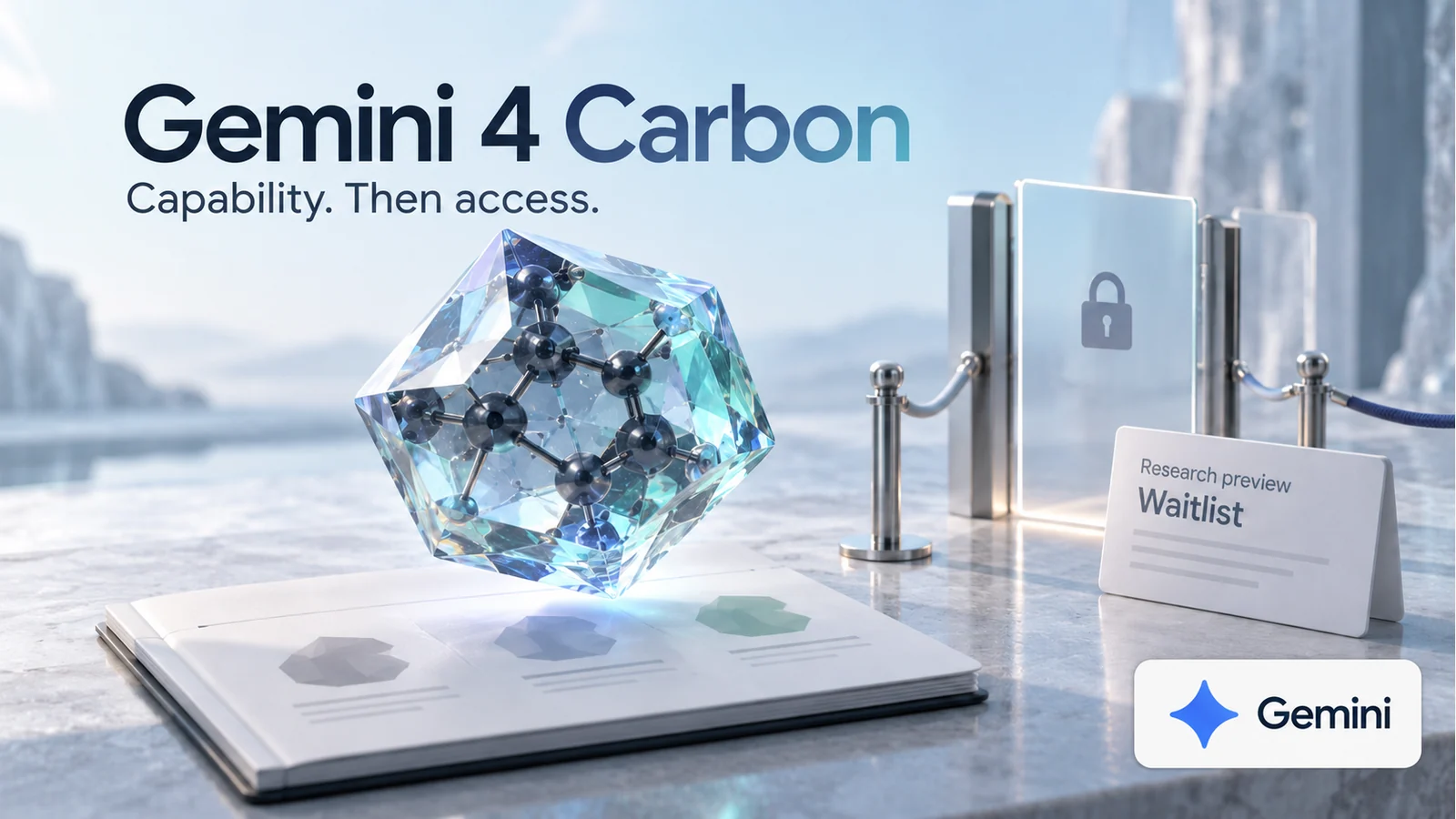
Gemini 4 Carbon tops an AI index. Access is the catch.
Google’s October 28 model announcement brings an independent benchmark lead, restricted access and a price footnote worth reading.
The 30-second bite
- Artificial Analysis places Carbon first on Intelligence Index v5; its separate coding-agent evaluation still has another leader.
- The first rollout is restricted. A public consumer or developer launch date has not been announced.
- A benchmark score is a shortlist signal; access, task fit and the cost of a completed job still decide usefulness.
A stronger model, with a narrow first audience
Google announced Gemini 4 Carbon on October 28, emphasizing cybersecurity and extended software-engineering work. Initial access goes to a subset of cyber defenders, followed by more trusted partners through its Fairwind Program. Wider availability is promised without a date.
For someone opening the Gemini app to try the latest release, that distinction changes the story. An announced model, a published evaluation and an available consumer feature are three different milestones. Carbon currently offers a preview of where the model family is heading, rather than a reason to assume your everyday assistant has already changed.
Sources: [1]
The independent score has an important wrinkle
Artificial Analysis separately reports a score of 59 and first place on its Intelligence Index v5. Its October 28 evaluation also puts Carbon with high reasoning and Antigravity CLI second on the Coding Agent Index, behind Claude Opus 5.5 in Claude Code. Those are different measurements, using particular configurations.
That distinction matters more than the headline ranking. If your task is debugging an application, use the coding evidence to form a shortlist. If it is assembling a presentation or analyzing a document, examine evidence for those jobs. The highest combined score does not establish that one model wins every part of your work.
Sources: [2]
What the intelligence index actually measures
The evaluator’s methodology combines nine evaluations across knowledge work, coding, science and general capabilities, with equal weight for each category. It is primarily an English-language, text-based suite. Some tasks include images; speech and multilingual performance are assessed separately.
Our reading: the overall result is evidence about that collection of tasks, rather than a universal verdict on an assistant. A Canadian student using French voice notes, for example, should ask for relevant language and speech evidence. A strong aggregate result cannot answer whether the app preserves names correctly, understands an accent or produces a useful study guide.
Sources: [3]
Fairwind is a vetted channel
The Fairwind page describes organizational vetting and prioritizes governments, critical infrastructure and core technology platforms. Applicants are directed to their Google Cloud account team. It is not an ordinary consumer signup page.
There is a source wrinkle worth keeping visible: that program page still describes Gemini 4 Argon. The newer Carbon announcement sets out the next rollout. Reading them together explains the access channel; it does not establish that every approved Fairwind partner already has Carbon. For a small team planning a launch, confirmed access should come before choosing a model around which to build.
Read both prices before comparing costs
Google lists introductory pricing of $2 per million input tokens and $10 per million output tokens. Its footnote doubles those figures after the introductory period; no end date is given. Artificial Analysis uses standard prices in its comparisons.
An illustrative calculation makes the difference concrete. One million uncached input tokens plus 100,000 output tokens would be $3 at the introductory rates, or $6 at standard rates. That is arithmetic, not a tested workload or a complete service quote. Tool charges, caching and additional generated tokens can change a bill. A cheaper-looking token rate also says little about how many attempts a finished task requires.
What to evaluate when access expands
Our suggested comparison starts with three recurring jobs you already understand. Keep the input and success criteria consistent, then record whether the output is usable, how much correction it needs and what the completed job costs. A coding task should include an explicit acceptance check; a research task should include checking the cited evidence.
Also decide how much freedom each job deserves. Preparing a proposed patch and applying it to a live service have different consequences. More capable software is still easier to assess when the required outcome, permitted actions and review point are clear. This is an evaluation approach for future access, not a claim that LLMBites has run Carbon through those tasks.
Why this matters
A model can advance the frontier while remaining unavailable for your workflow. Reading capability, rollout and cost together turns a launch headline into a more useful decision.
Rankings and access reflect the sources checked on October 29. We have not tested Carbon, and no general release date is confirmed.
Sources & reporting
- 01Gemini 4 Carbon: our next frontier modelGoogle · Oct 28, 2026
- 02Gemini 4 Carbon is the new #1 on the Artificial Analysis Intelligence Index v5Artificial Analysis · Oct 28, 2026
- 03Artificial Analysis Intelligence Benchmarking MethodologyArtificial Analysis · Checked Oct 29, 2026
- 04Fairwind ProgramGoogle DeepMind · Checked Oct 29, 2026
AI-assisted research and drafting. We read Google’s announcement and access-program page alongside Artificial Analysis’s evaluation and methodology. The evaluator is a separate origin; the two Google pages are not independent corroboration. Practical comparisons above are our analysis.
Spot a mistake? Request a correction.