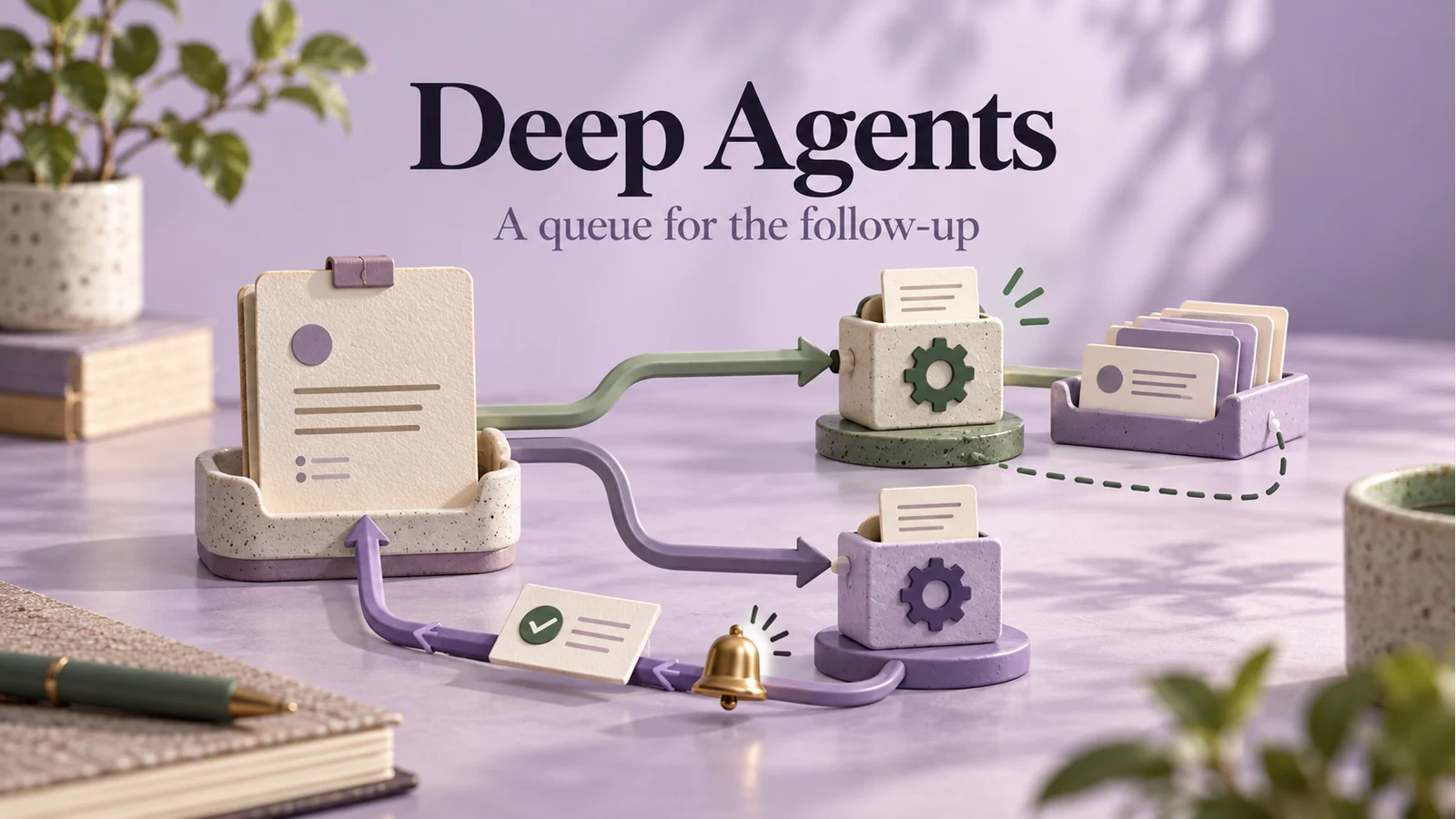
Deep Agents can queue a follow-up without stopping the job.
An October 22 update gives background agents another way to receive instructions. It is a coordination change, with important limits around status, review and human input.
The 30-second bite
- Deep Agents 0.7.30, released October 22, added queued follow-ups for asynchronous subagents, plus webhook and parent-notification controls.
- The documented queue strategy is optional; interrupting active work remains the default, and the new controls carry beta caveats.
- The MIT-licensed harness still needs a suitable model and execution setup. LLMBites has not run this workflow or measured a productivity improvement.
“One more thing” is a real agent-design problem
You ask an assistant to research a topic, then remember a second requirement while it is still working. Should the new instruction stop the job, or wait its turn? Deep Agents 0.7.30, released on October 22, adds a queued option for asynchronous subagent follow-ups. The same release adds webhook delivery and a control over whether a finished worker can notify its parent.
It is a small change with an everyday consequence: an application can treat a follow-up as more work to schedule rather than an automatic interruption. But this is a feature in a developer toolkit, not a new consumer assistant or proof that a team of agents produces better answers. Its value depends on how the application handles the work between the initial request and the reviewed result.
Sources: [1]
The project supplies a harness, not a finished newsroom
Deep Agents is an open-source agent harness from LangChain. Its versioned README describes a package that combines planning-oriented tools, files, delegation, context management and optional human review. It sits on the LangChain and LangGraph stack and can work with models that support tool calling. Developers still provide the particular task, tools, model and execution environment.
That makes it relevant to people building research or editorial workflows, but it should not be mistaken for the workflow itself. Naming one worker “researcher” does not give it source judgment. Naming another “reviewer” does not establish that it checked the evidence. The useful design work is to define the material each worker receives, the evidence it returns and the decision a person will make with it.
Sources: [2]
A follow-up needs its own definition of done
Imagine a background worker comparing a product’s availability in the United States. The user then asks for Canada too. With a queued follow-up, the application could let the existing assignment finish and schedule the additional request. The important word is “could”: this is a hypothetical use case, not a run observed by LLMBites.
A tidy queue alone would not make the first answer cover both countries. The interface should say which scope is complete, which work is waiting and whether a combined answer has been checked. A final summary should preserve the source dates and distinguish a regional restriction from missing documentation. Otherwise, a smoother orchestration layer could hide a familiar mistake: presenting an unfinished comparison as a finished answer.
Sources: [1]
The queue is optional, and approval still needs care
The current documentation says async workers communicate with an Agent Protocol-compatible server. A supervisor can launch work, inspect status, update it or cancel it. The follow-up strategy defaults to interrupt; developers choose enqueue to put a new run behind active work. The documentation marks the new strategy and parent-notification control as beta, so the API and behavior can change.
There is an important edge case in that documentation: if the active run pauses for input or approval before the queued follow-up starts, the follow-up still starts and the pending request is dropped. A development team should test that behavior explicitly rather than assuming a queue preserves every approval prompt. The same guide says the supervisor cannot approve on the user’s behalf; the application handles that request on the worker’s own thread.
Sources: [3]
Decide who delivers the result
The new webhook option allows the server to notify an application when a worker run finishes. Parent notifications can be switched off when the application should deliver the result instead. This offers a choice about who gets awakened and where a result appears; it does not remove the need to show the user whether work succeeded, failed or still needs attention.
Our practical test would start with one worker and a task whose outcome can be inspected. Send an additional requirement while it is active, then check the order of execution and the final scope. Repeat with a cancellation and a request for human input. Record what the user actually sees in each case. These are proposed acceptance checks, not performance results or a claim that LLMBites has validated the implementation.
Sources: [3]
Open-source code still has an operating cost
The repository’s code is MIT-licensed, with its copyright and permission notice to retain when required by that licence. That does not grant access to a hosted model or deployment service. The selected model, the worker’s tools and the infrastructure running those tasks have their own requirements and costs. More simultaneous workers can also mean more work for the person reviewing their output.
For a small project, the sensible comparison is against a simpler workflow. Ask whether background execution makes a particular task easier to follow and whether the extra result is worth its review time. If a single assistant can complete a short task clearly, delegation may add machinery without adding value. The October update makes coordination more configurable; it does not make delegation the right default for every problem.
Why this matters
The next useful improvement in agents may be less about adding workers and more about making their progress understandable. Queued follow-ups can support that goal when scope, status and human decisions stay visible.
This article examines the October 22 release and documentation checked October 29, 2026. LLMBites did not install Deep Agents, run a multi-agent workflow or independently measure its reliability, cost or speed. Beta behavior and later versions may differ.
Sources & reporting
- 01Deep Agents 0.7.30 release notesLangChain on GitHub · Oct 22, 2026
- 02Deep Agents README at version 0.7.30LangChain on GitHub · Checked Oct 29, 2026
- 03Async subagents: lifecycle, queued updates and result deliveryLangChain documentation · Checked Oct 29, 2026
- 04Deep Agents MIT licence at version 0.7.30LangChain on GitHub · Checked Oct 29, 2026
AI-assisted research and drafting. Source-based reporting from the versioned Deep Agents release, README, licence and current async-subagent documentation. These are first-party LangChain materials, not independent performance verification. The country-comparison scenario and acceptance checks are LLMBites analysis and have not been executed.
Spot a mistake? Request a correction.