
Infinity Machine’s research results come with a useful warning.
An October 26 preprint explores AI-led discovery. Its account of failed checks is a reminder to look beyond a promising result.
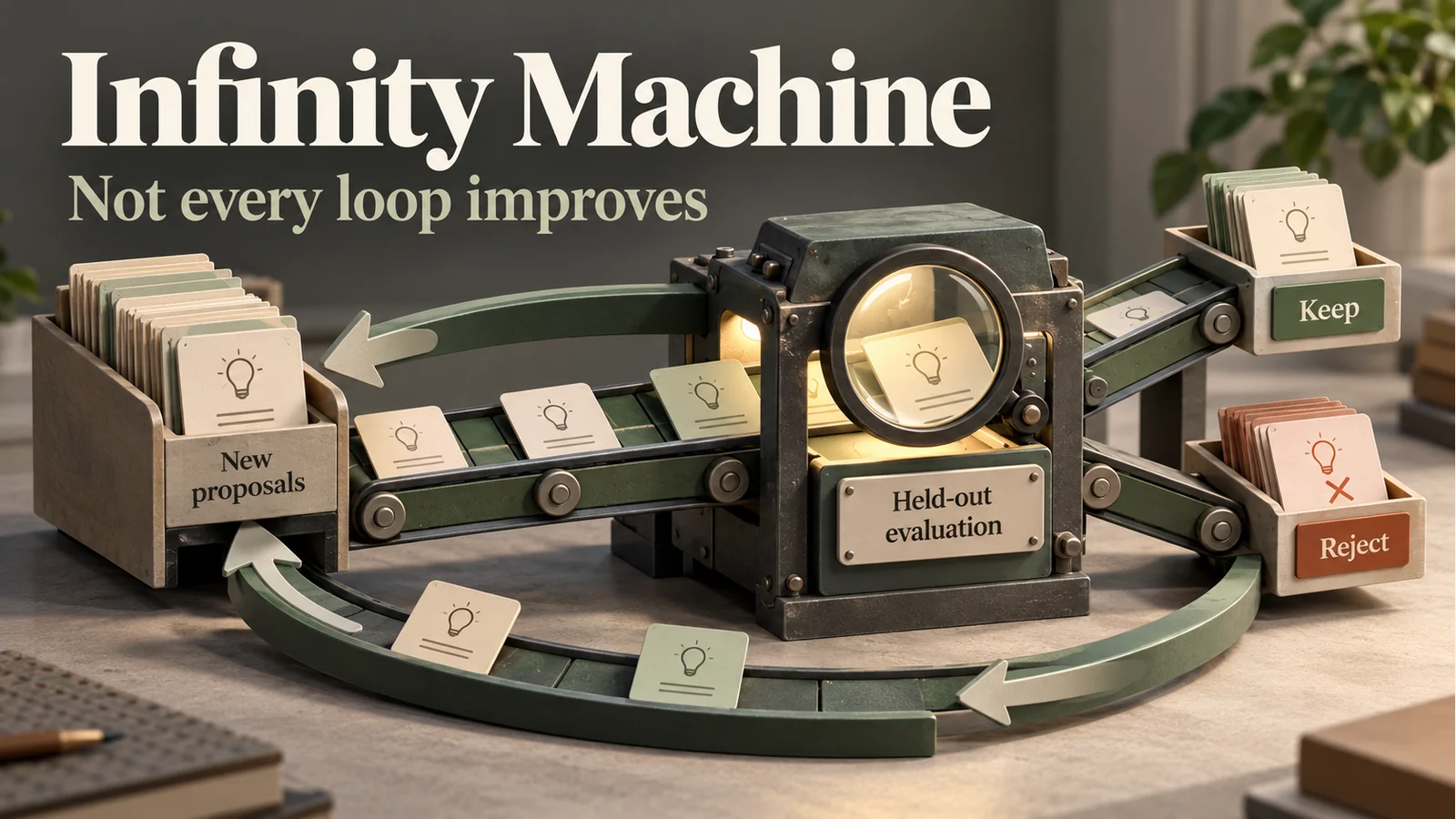
The 30-second bite
- Infinity Machine separates proposed research solutions from verification.
- Three end-to-end autonomous runs matched existing records; reported advances came from operator-led campaigns.
- The practical takeaway is to examine the evaluator, the comparison and human input before treating an AI result as a discovery.
The result is only half the story
A polished AI research summary makes progress look tidy: a problem goes in, an improved answer comes out. The harder question is what would have stopped a convincing but wrong answer from counting. That question gives a new research-agent preprint a useful angle for readers who do not work in a laboratory.
In an October 26 preprint, Harish Santhanalakshmi Ganesan separates proposed research solutions from checks controlled by a different part of Infinity Machine.
Sources: [1]
An idea generator still needs a measuring instrument
The general approach has an established precedent. Google DeepMind’s AlphaEvolve white paper describes an evolutionary coding process: models propose programs, evaluators score them and a database supplies material for later attempts. It concentrates on problems whose proposed answers can be assessed automatically. That is a boundary on the method, not a claim that a general chatbot can settle any research question.
Think about improving a delivery route. A shorter route is not useful if it misses a required stop. The measurement has to preserve the rules of the task while checking the target that matters. A system can become better at satisfying a score while becoming less useful to the person who chose the problem.
Sources: [2]
Where this preprint draws the line
Its self-derived update was rejected on cost. Another automated check missed a score pointing in the wrong direction. Those are the paper’s findings, not proof of sustained self-improvement.
For a reader, the useful follow-up is a request for a chain of evidence: the original task, the rule used to judge it, a saved candidate and a fresh check. If a summary only supplies the final score, that chain has gaps. A result can be worth investigating while the broader story around it remains unproven.
Sources: [1]
Correct, allowed and faster are different questions
Google Cloud’s current AlphaEvolve documentation separates validation, correctness verification and performance evaluation. It advises calculating the score deterministically rather than asking the language model to calculate it. This is contextual guidance from a different system; it does not independently verify Infinity Machine.
That separation is useful outside specialist research. A generated spreadsheet formula can be syntactically valid and still answer the wrong question. A scheduling script can meet its deadline goal while leaving out a difficult case. Before comparing speed, a reviewer needs to decide what must remain true and what failure should look like.
Sources: [3]
Do not confuse the operator with the autonomous run
The reported advances came from operator-led work; three autonomous runs matched existing records. Single-operator/model evidence and unmatched compute limit the comparison.
This matters when assessing an AI discovery headline. The question is not whether a human was involved somewhere; research is collaborative. It is which choices the system made, which choices a person supplied and whether the reported comparison credits both honestly. Hiding those choices makes a demonstration harder to evaluate, even if the individual output is correct.
Sources: [1]
A better way to read the next discovery claim
Our reading guide is to separate four things: the proposed object, the check that accepts it, the baseline it improves and the scope of that improvement. Ask whether a separate check can be repeated, whether the baseline received comparable resources and whether a rejected attempt appears alongside the success. Those questions do more work than a label such as autonomous.
The preprint is worth reading as an account of a research workflow and its failure modes. It is not a reason to replace scientific scrutiny with confidence in an agent. For a non-specialist reader, that is the useful shift: spend less attention on how impressive the answer sounds and more on the test that could prove it wrong.
Why this matters
AI-assisted discovery becomes easier to judge when the proposal, verification process and human contribution are visible. The quality of the check determines how much confidence a result deserves.
Coverage of arXiv:2610.35579v1, a preprint. Peer review and external validation have not been established here; LLMBites has not reproduced the results.
Sources & reporting
- 01Infinity Machine: a self-improving AI agent for research — v1Harish Santhanalakshmi Ganesan / arXiv · Oct 26, 2026
- 02AlphaEvolve: A coding agent for scientific and algorithmic discoveryGoogle DeepMind · Checked Oct 29, 2026
- 03AlphaEvolve evaluator implementation patternsGoogle Cloud · Checked Oct 29, 2026
Research and drafting used AI assistance. Full-text methods, operator involvement, failure analysis and limitations informed this report. AlphaEvolve sources provide context, not replication.
Spot a mistake? Request a correction.